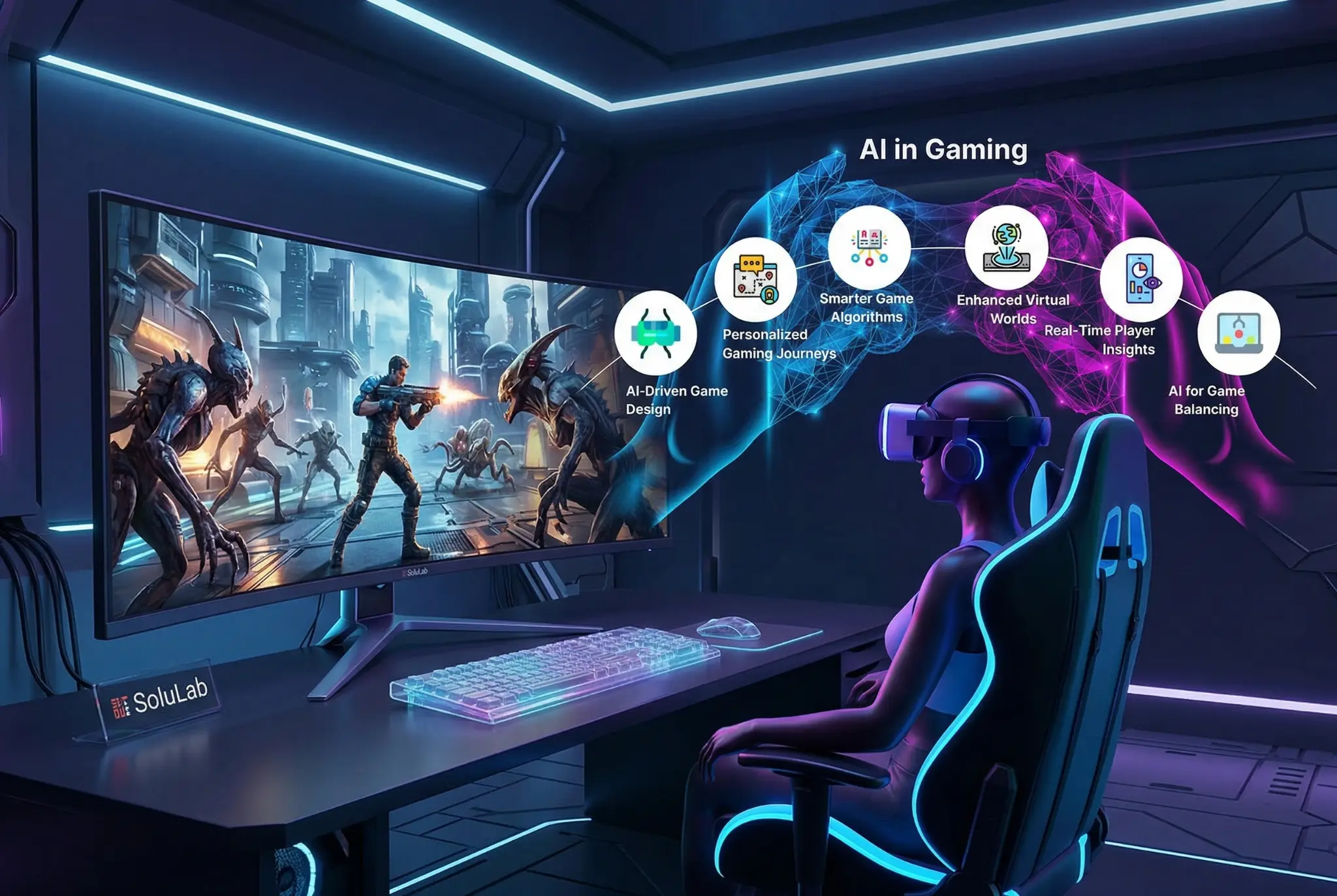
Gaming is about to change in a way that makes the jump from 2D to 3D look modest.
Not because of better graphics. Not because of faster processors. Because artificial intelligence is no longer a tool developers use to build games. It is becoming a component of the game itself. Running live. Responding to you specifically. Adapting in real time to decisions you have not made yet.
The conversation about AI in gaming has been happening in tech circles for years. In 2026 it stopped being a conversation and started being a product.
Here is exactly what is happening and where it goes next.
The NPC Problem Nobody Talks About
Spend five minutes in any open world game released in the last decade and you will find them. NPCs standing in the same spot they occupied yesterday. Repeating the same three lines of dialogue on a loop. Reacting to a dragon attack with mild curiosity before returning to their assigned position and continuing their predetermined animation.
It is the single biggest immersion breaking element in modern gaming and the industry has largely accepted it as an unavoidable limitation.
AI is about to make that limitation look embarrassing.
NVIDIA's ACE technology — Avatar Cloud Engine — is already in production titles. It gives NPCs the ability to hold genuine conversations. Remember previous interactions. React to the state of the world around them rather than executing pre-written scripts. The technology uses large language models running either in the cloud or directly on RTX hardware to generate responses in real time.
The practical result is an NPC that does not just tell you where the blacksmith is. It notices you are wearing armor it has seen you wear for three days. It asks why you have not repaired it. It remembers you helped its cousin two towns over. It adjusts its pricing based on your reputation in this region of the map.
That is not a feature. That is a fundamental reimagining of what a game world can be.
Procedural Everything
The traditional game development pipeline looks like this. A writer writes a story. A designer builds a level. An artist creates assets. A programmer connects all of it. The player experiences the finished product and eventually reaches the edge of the content.
AI is dismantling that pipeline from both ends.
Procedural generation is not new. No Man's Sky built entire planets algorithmically in 2016. What is new is the quality threshold. Early procedural content was identifiable by its repetition and its emptiness. You could feel the algorithm behind it.
Modern AI generation produces content that humans struggle to distinguish from handcrafted work. Ubisoft's NEO NPC system generates mission dialogue dynamically. Square Enix has been exploring AI generated side quests that adapt to the player's completed story beats. Microsoft Research published work on AI systems that generate level geometry responding to a player's documented skill level.
The implication is a game that genuinely does not end. Not because it loops. Because it keeps building.
An RPG that generates a new questline based on three choices you made six hours ago. A survival game that designs encounters specifically targeting the playstyle you have developed over forty hours. An open world that writes new history for regions you have already explored based on the political consequences of your actions in regions you cleared last week.
This is not science fiction. The component technologies exist right now. The games that assemble them into a coherent product are in development today.
The Performance Revolution Nobody Credited Correctly
DLSS 5 gets discussed as a performance tool. Frame rates. Resolution. Benchmark numbers on GPU review sites.
That framing undersells it almost completely.
What DLSS 5 actually represents is AI taking creative ownership of visual output. The rendered frame is now a starting point rather than a finished product. The AI examines it, reconstructs it, and in some cases replaces significant portions of it with generated imagery that was never rendered by the GPU at all.
Frame generation takes this further. The AI is not just enhancing frames. It is authoring them. Creating visual information from inference rather than calculation.
Apply that logic beyond frame generation and the implications accelerate quickly.
An AI system trained on a game's visual language that can generate background geometry. Populate distant crowds. Create weather systems that are visually consistent with the art direction without being individually authored. Animate secondary characters at a fidelity level that would previously require dedicated motion capture sessions.
The artists still define the vision. The AI executes the volume. The gap between what a small development team can produce and what a large one can produce begins to close in ways the industry has never seen before.
Adaptive Difficulty Done Right
Adaptive difficulty has existed in gaming for twenty years. Resident Evil 4 famously adjusted enemy health and damage based on your performance. Players noticed it almost immediately and the community debated whether it cheapened the experience or improved it.
The problem with early adaptive difficulty was its crudeness. The system watched two variables. Win rate and death rate. It adjusted a multiplier. The result felt mechanical because it was mechanical.
AI driven adaptive systems watch everything simultaneously.
How long you pause before entering a room. Which enemies you prioritize and which you avoid. Whether you use environmental cover or prefer open engagements. How much ammunition you conserve versus expend. The speed of your menu navigation. The frequency of your save states.
A system processing all of that data does not just make enemies harder or easier. It redesigns the encounter around your documented tendencies. It learns that you struggle with flanking enemies but handle direct confrontations well. It places the next ambush accordingly. Not to punish you. To challenge the specific weakness you have demonstrated while leaving your strengths intact.
The result is a game that feels like it was designed specifically for you. Because in a meaningful sense it was.
The Elephant In The Room
None of this arrives without consequences worth examining honestly.
The games industry employs writers, designers, artists, voice actors, and narrative directors whose work is directly adjacent to everything AI is learning to do. The technology does not care about that adjacency. It will generate a side quest script, a piece of background dialogue, a texture variation, and a crowd animation with equal indifference.
The studios integrating these tools are not uniformly transparent about where the line sits between human authorship and machine generation. Some are explicit. Most are not. The players experiencing the output rarely know which is which.
There is also the question of what happens to games as personal creative statements when the system generating their content is optimizing for engagement metrics rather than artistic intent. The games that defined the medium — Shadow of the Colossus, Disco Elysium, Outer Wilds — were built on specific, stubborn, occasionally uncomfortable creative visions. An AI optimizing for player retention would have softened every single one of them.
The technology is genuinely extraordinary. What the industry chooses to do with it will define whether the next generation of games feels like an expansion of what came before or a replacement of it.
What Comes Next
The immediate future — the next two to three years — looks like this.
More NPCs with genuine conversational memory. Open world games where the world state evolves based on aggregate player behavior across the entire player base rather than individual save files. AI generated music that composes dynamically to match moment to moment gameplay tension rather than looping ambient tracks. Visual fidelity that makes the rendering pipeline invisible.
The further horizon is harder to see clearly.
An AI dungeon master that runs a genuinely reactive tabletop experience inside a game engine. A narrative system that generates a personal story so specifically tailored to your history with a game that no two players ever experience the same protagonist arc. A virtual world that does not distinguish between authored content and generated content because the quality threshold between them has collapsed entirely.
Gaming has always been the medium that pushes technology hardest. It has always been the place where new capabilities become products before any other creative industry touches them.
AI is the biggest capability the medium has ever had access to.
What the best developers build with it over the next decade will be worth watching very closely.
Follow TecBlitz for weekly gaming tech features, hardware reviews, and the honest take on where the industry is going. ⚡
More Articles
Interested in More Tech Insights?
Subscribe to our newsletter for the latest gaming reviews and tech news delivered to your inbox.